Korn Ferry CEO Gary Burnison recently reduced organizational culture to a wonderfully simple idea: culture is how things get done.
I have been thinking about that sentence because I agree with it, but I also think there is another question hiding underneath it.
How do things actually get done?
Not how organizations say they get done. Not the process map, leadership competency model or strategic plan. I mean the physical act of turning intention into performance. A group of people enters a room, a factory, a hospital, a football pitch or a meeting. Something needs to happen. Somehow, those people must know what matters, understand what is expected of them, trust the people around them and act.
Then they have to do it again.
I found myself thinking about Herr Weiss.
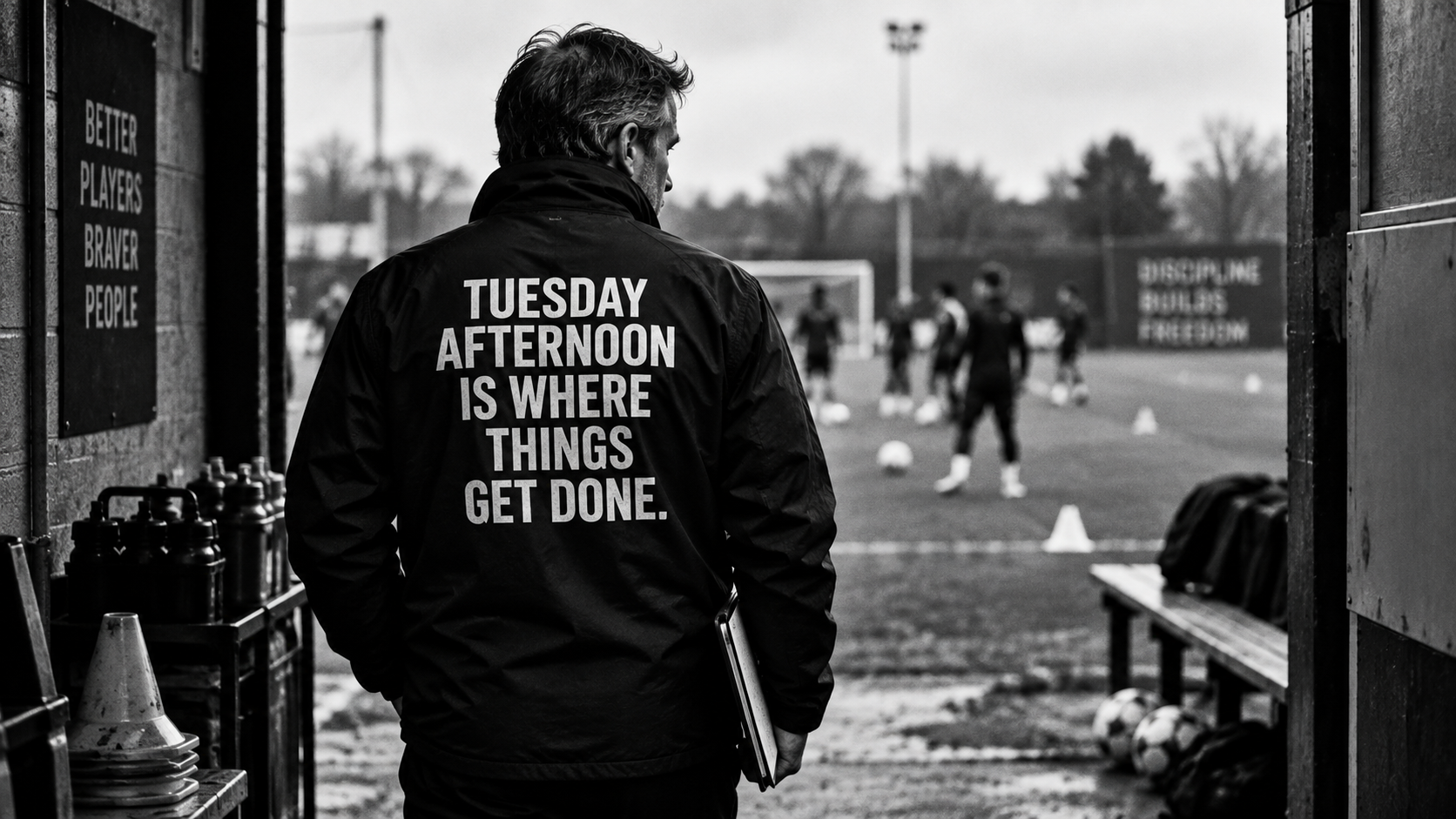
Herr Weiss is a character I spent considerable time developing while writing The Desert Witness. He coaches football in Germany. He is precise without being theatrical, demanding without becoming cruel and serious without confusing seriousness with volume. He does not need inspirational speeches. He does not manufacture urgency. Most importantly, he understands something that organizations often make unnecessarily complicated.
People become more of what they practice.
His players learn positioning. They learn shape. They learn where the next pass should go before the ball arrives. They learn that representing the club extends beyond the pitch. They learn what effort looks like partly from the coach, but increasingly from one another.
And every Tuesday afternoon, they practice.
There is something almost disappointingly ordinary about it.
No transformation initiative. No launch. No slogan.
Tuesday afternoon.
That may be much closer to how things get done than most of what we call leadership.
Burnison describes leaders as both culture champions, who model expected beliefs and behaviors, and culture architects, who create the structures that make those behaviors possible. It is an important distinction because organizational performance requires both. Telling people what matters without creating the environment in which they can practice it produces aspiration. Creating processes without reinforcing why they matter produces bureaucracy.
The interesting territory sits between them.
That is where people work.
Soccer makes this unusually easy to see because the feedback is immediate. A beautifully written statement about teamwork becomes irrelevant when three defenders fail to communicate. A commitment to excellence means very little when a midfielder stops tracking back. The organizational chart cannot save a goalkeeper who does not trust the center back in front of him.
The ball exposes the culture.
So does pressure.
Watch an experienced football side move the ball and much of what happens appears instinctive. It is not. A player receives the ball and already knows where another player should be. Someone makes a run before the space appears. A defender moves several yards because another defender moved several yards. Eleven individuals gradually begin behaving like a single system.
That coordination was built somewhere.
Usually on a Tuesday afternoon when nobody was watching.
This is one reason I have become increasingly skeptical of our tendency to separate strategy, culture and execution as though they were distinct managerial subjects. In practice, they collide constantly.
Strategy says where we intend to go.
Culture establishes how people behave while going there.
Execution reveals whether any of it was real.
The separation exists beautifully in PowerPoint. Human beings are less cooperative.
Herr Weiss would probably have little patience for the distinction. His coaching is developmental. He corrects positioning because positioning matters. He repeats an exercise because repetition matters. He expects players to represent the club properly because belonging carries obligations. He recognizes improvement quietly because praise has value when it communicates something specific.
There is no need to declare that the club values accountability.
The player standing beside you will tell you when you have stopped running.
That is culture becoming operational.
It also points toward something I think we routinely underestimate in organizations: standards become powerful when the group begins carrying them for the leader.
A team cannot reach sporting excellence if the coach remains the sole enforcement mechanism. Eventually the players must know what good looks like. Better still, they must care enough to protect it.
The same holds inside an organization.
When every decision requires escalation, the culture has not matured. When employees need a manager to explain whether something meets the standard, the standard has not become part of the operating system. When a customer receives extraordinary service only because a senior leader happens to be watching, hospitality is an event rather than a culture.
Masterful performance begins when people know what the organization expects even when nobody is watching.
This does not eliminate leadership. It makes leadership more consequential.
The leader establishes the conditions.
One of the lines that emerged while I was writing Herr Weiss has stayed with me: he gave the thing in front of him what it required.
That sounds small until you consider how often organizations do the opposite.
We give the customer what the process requires.
We give the employee what policy permits.
We give the meeting the presentation we prepared rather than the conversation the room requires.
We give difficult problems another committee, another dashboard or another month because institutional motion can feel remarkably similar to progress.
Herr Weiss simply looks at the situation in front of him.
What does this require?
Then he acts.
There is another part of his story that changed how I thought about this.
Herr Weiss becomes seriously ill. Yet he continues coaching. The explanation is not heroic. It is almost stubbornly practical.
The boys still need Tuesday afternoon.
His diagnosis does not change Tuesday afternoon.
I love the idea because it is not really about stoicism. It is about stewardship. Something has been entrusted to him. His circumstances have changed, but the needs of the people standing in front of him have not.
That is a very different conception of leadership from the leader as protagonist.
The work remains the protagonist.
The team remains the protagonist.
The standard remains the protagonist.
Leadership creates the conditions under which those things can endure.
This is also where I think many discussions about organizational culture become too abstract. We ask whether employees understand the mission. We measure engagement. We publish values. We create competency frameworks.
Those things can matter.
But perhaps we should also walk into the organization on an ordinary Tuesday afternoon.
What happens when a customer needs help and nobody quite owns the problem?
What happens when someone misses a deadline?
What happens when the most junior person in the room sees the flaw in the plan?
What happens when a high performer behaves badly?
What happens when the procedure no longer fits the situation?
What happens when nobody important is watching?
Those moments tell us far more about culture than the words mounted behind reception.
They also tell us how things get done.
The organizations that perform beautifully are rarely beautiful because every person is extraordinary. Sporting excellence teaches us that. Great teams contain different abilities, personalities and roles. What distinguishes them is that individual effort becomes coordinated effort. People understand the system well enough to operate within it and trust it enough to occasionally move beyond it.
The spectacular play comes later.
First comes positioning.
First comes repetition.
First comes knowing where your teammate will be.
First comes learning what the shirt means.
First comes Tuesday afternoon.
Perhaps this is why excellence can be difficult to manufacture through large organizational programs. We naturally gravitate toward visible interventions because visible interventions look like action. But much of performance architecture is quieter. Expectations become clearer. Behaviors become repeatable. Decisions move closer to the people capable of making them. Standards become social rather than managerial. Trust accumulates through thousands of small confirmations.
Eventually something interesting happens.
The organization begins moving differently.
People anticipate one another.
Problems get handled closer to where they occur.
Customers experience consistency without seeing the machinery producing it.
Leaders spend less time pushing because the system has learned how to move.
From the outside, we call that culture.
From inside the organization, it probably feels much simpler.
It is just how things get done.
And somewhere behind almost every organization that makes difficult work look easy, there was probably a Tuesday afternoon when somebody decided that the ordinary work was worth doing exceptionally well.