Roger Federer once described one of the most important lessons of tennis with a statistic that almost sounds wrong the first time you hear it.
He won nearly 80 percent of his matches.
He won only about 54 percent of the points.
For one of the greatest players in the history of the sport, nearly half of the individual moments ended in failure.
That number stayed with me because it changes the way I think about excellence. We tend to remember the championships, the match points and the photographs taken with trophies. Careers get reduced to outcomes. Federer’s career looked almost impossibly successful from that distance, yet the actual experience of playing tennis required him to lose thousands of points and then stand in exactly the same place a few seconds later ready to play another one.
The skill was not simply winning more often.
He had to learn how to let the previous point end.
Christopher Clarey’s The Master helped me see Federer differently because the book spends so much time around the edges of the tennis. Federer is still the extraordinary athlete we remember, but Clarey also shows the family traveling through cities, the children going to museums, the familiar people who remained around him for years and the constant effort to keep tennis from swallowing everything else.
Federer called this compartmentalization.
The word initially sounds colder than the life it describes. It suggests putting emotion into boxes and shutting the lid. What Federer actually practiced was much more human. He could allow something to matter completely while it was happening and then gradually return it to its proper size.
The 2019 Wimbledon final may be the clearest example.
Federer held two championship points against Novak Djokovic and lost.
There are defeats that disappear into a career and there are defeats that seem designed to follow someone forever. This was the second kind. Wimbledon had become inseparable from Federer’s public identity. He had been one point from another title, twice, before the match moved away from him.
The conventional high-performance story almost writes itself from there. Keep the loss close. Turn it into fuel. Remember it every morning. Let the pain sharpen the next training session.
Federer did not pretend the match meant nothing. Clarey makes clear that the disappointment remained. But life soon resumed around it. Federer was traveling through Switzerland with his family, organizing children, eating meals and doing the ordinary work of being somewhere other than Centre Court.
The match still existed.
It just no longer occupied the whole landscape.
That difference matters to me.
We often treat obsession as evidence of commitment. The executive who cannot stop thinking about work must care more. The athlete who carries every defeat into the next practice must be more competitive. The person who remains psychologically clenched must somehow be demonstrating seriousness.
Federer’s career suggests another possibility.
Perhaps sustained excellence depends partly on knowing when seriousness has completed its work.
Clarey describes Federer visiting museums and parks with his children before night matches. Another player might spend those hours in a hotel room conserving energy, thinking through patterns or mentally moving closer to competition. Federer could leave tennis for a while.
Then he could return to it.
That distinction feels small until you consider a career measured across decades.
A person cannot remain at competitive temperature forever. Even if the body survives, the mind eventually begins to treat the thing it once loved as another source of pressure. Federer seems to have understood that recovery involved more than treatment tables and rest days. Sometimes recovery meant entering a different world long enough for tennis to stop being the only thing happening.
Family became part of that architecture.
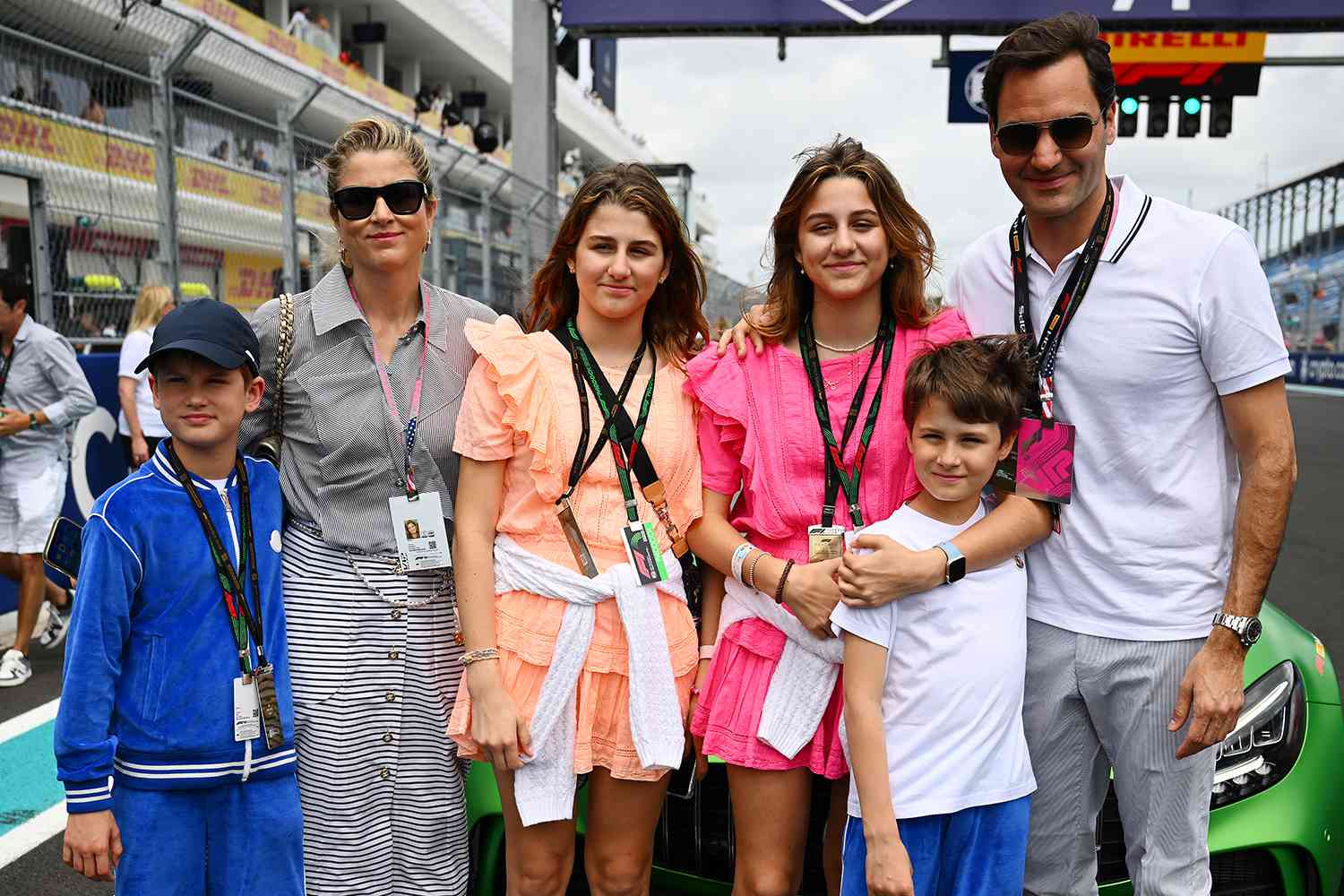
When Federer and Mirka began traveling with their children, they made an already demanding professional life considerably more complicated. Four children do not simplify international travel. They do not recognize that a Grand Slam final is supposed to reorganize the universe around it.
They still need meals.
They still want to go somewhere.
They still have their own concerns.
That complication may have been part of the benefit.
Federer did not have to wait until retirement to become a father who was present in the ordinary flow of family life. The family entered the career rather than standing outside it for twenty years waiting for tennis to finish.
There is an important qualification here. Federer’s resources made this possible in ways that would be unrealistic for most people, and Mirka carried an enormous share of the work required to make the system function. Any romantic version of the story that forgets her labor misses something essential.
But the principle travels better than the lifestyle.
Federer built a professional life that did not require every other part of him to disappear.
I think this is where his career becomes much more interesting than another story about a gifted athlete.
He protected his curiosity. He formed long relationships with people he trusted. He changed coaches without repeatedly destroying the core around him. He altered his game as he aged. He reduced his schedule when more tennis stopped being better tennis. He traveled constantly but retained Switzerland as home.
The system had movement, but it also had a center.
That may be why the familiar description of Federer as effortless has always bothered him.
Nothing about this was effortless.
The economy of movement came from work. The calm came from experience. The longevity came from thousands of choices about what deserved energy and what did not.
Even the elegance had infrastructure.
As I read Clarey and listened again to Federer’s Dartmouth address, I began thinking less about balance and more about proportion.
Balance suggests that every part of life receives an equal share.
That was never Federer’s life. Tennis sometimes demanded almost everything. There were tournaments, rehabilitation, travel and long periods when the career clearly dominated the calendar.
Proportion asks a different question.
Does the thing that matters most right now still occupy the right amount of your total life?
That question travels well beyond sport.
A difficult project can become the only conversation inside an organization. A bad meeting can occupy an evening. A failed decision can shape the next decision long after the original circumstances have changed. Leaders can become so identified with solving one problem that they continue carrying it after there is nothing left to solve.
We call some of this dedication.
Sometimes it is simply failure to release.
My years as a goalkeeper taught me a primitive version of the same lesson.
There were moments when the world became extremely small. A striker, the ball, the angle, my feet and the distance between us could become everything.
They needed to become everything.
But the whistle eventually blew. The locker room emptied. The gloves went into the bag. The match had to become something that had happened rather than something that was still happening.
I did not have Federer’s language for it then.
I understand it better now.
Sustained performance requires the ability to move between intensity and release without diminishing either one. You have to care enough to give the moment everything it deserves and remain proportionate enough to recognize when the moment has ended.
Federer spent a career learning how to do that.
Perhaps that is why the 54 percent matters so much.
He did not become great because every point went his way.
He became great partly because the points that did not go his way eventually stopped following him.
The next one was waiting.