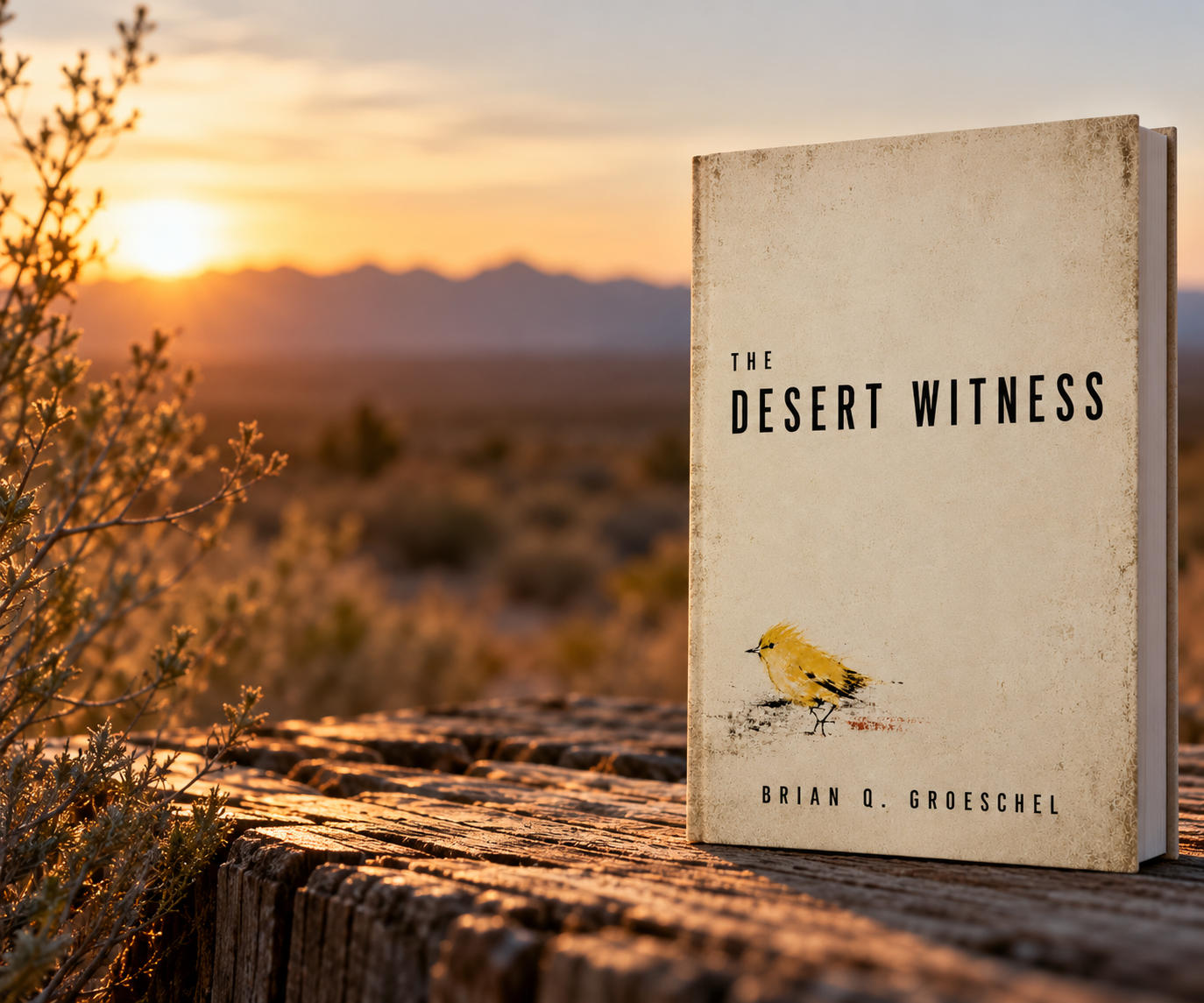
I began The Desert Witness with a boy, a g*un and a bird.
Julian is young enough to understand the rule his grandfather has given him, but not yet old enough to understand why the rule matters. Never shoot something you are not going to eat. One morning in the California desert, he sees a small warbler beneath a tree, raises the gun and fires simply because he wants to know whether he can hit it.
He can.
What follows is more important than the shot. Julian walks toward the bird, picks it up and discovers that something which seemed small from a distance becomes very different when it is resting in your hand. He knows immediately that what he has done is wrong. He also knows what he should do next. He should carry the bird home, place it before his grandfather and tell the truth.
Instead, he leaves it beneath the tree.
That moment became the moral beginning of The Desert Witness.
The novel grew from a question that has interested me for years: What happens to us when we know the right thing, fail to do it and then become exceptionally good at living around that failure?
Julian does not become an immoral man. Quite the opposite. He becomes disciplined, capable and deeply committed to service. Germany teaches him how belonging can be earned through work. A goalkeeper learns to read the field before the play arrives. Coaches, family, friendship and love teach him that excellence is rarely theatrical. The people who most profoundly shape him are often people who simply show up, pay attention and perform the work in front of them extraordinarily well.
Later, medicine gives that instinct a profession.
As a surgeon, Julian develops a simple private law: if a life can be saved and saving it is within reach of his hands, he will not fail it through vanity, fear or convenience. Military service sharpens that commitment. Difficult rooms teach him that competence matters, but presence matters too. Sometimes the person suffering in front of us needs technical excellence. Sometimes he needs to know that another human being has not psychologically left the room.
Julian becomes very good at staying.
Yet competence creates its own danger.
A person can become so useful to institutions, organizations and other people that usefulness begins to substitute for identity. The work remains excellent. Responsibilities are met. Other people trust him. From the outside, everything appears intact.
Inside, something can slowly disappear.
That tension became one of the central concerns of the novel. We live in a culture that is exceptionally good at measuring performance. We measure productivity, outcomes, efficiency, utilization, engagement and almost every other visible expression of human effort. Those measurements matter. I have spent much of my professional life believing deeply in standards, systems and the disciplined pursuit of excellence.
But there are things a system cannot easily measure.
Did you remain present when leaving would have been easier?
Did you tell someone what he meant to you while there was still time?
Did you protect the person whose interests were inconvenient to the institution?
Did you tell the truth when silence offered the safer career?
Did the person who finished the journey still resemble the person who began it?
Those questions eventually became more important to The Desert Witness than the machinery of its plot.
The novel moves through four broad movements: formation, service, betrayal and witness. Julian’s life expands from the California desert into Germany, military medicine and places where history is being made by people who rarely experience its consequences directly. Along the way, he encounters men and women who teach him different forms of excellence. Some teach through precision. Some through courage. Some through restraint. Some simply refuse to leave when another person needs them.
He also encounters institutions capable of taking admirable human qualities and turning them toward purposes the individual never intended.
That interested me enormously.
Duty is good. Loyalty is good. Professionalism is good. Excellence is good. But none of those qualities absolves us of judgment. In fact, the more capable we become, the greater our obligation to understand what our capability is serving.
A skilled person can become extraordinarily useful to the wrong purpose.
That does not make skill dangerous. It makes moral awareness indispensable.
The second major character, Leah, allowed me to explore the same problem from another profession. She is a journalist rather than a surgeon, but she carries her own form of attentiveness. She learns rooms quickly. She understands what people expect. She knows how to make difficult material responsible, defensible and publishable.
Those are strengths.
Until caution begins removing the very thing that made the truth consequential.
Her journey helped me examine a distinction I increasingly believe matters far beyond journalism: there is a difference between being accurate and being complete. We can sometimes present facts that are technically correct while removing enough context to change what those facts mean. Institutions often become very sophisticated at this. So do individuals.
We rarely tell ourselves that we are hiding the truth.
We tell ourselves that the timing is wrong. The evidence needs strengthening. The audience is not ready. The consequences require consideration. Someone more qualified should act. A better opportunity will come.
Sometimes those judgments are wise.
Sometimes they are fear wearing professional clothing.
That ambiguity is where I wanted the novel to live.
I did not want The Desert Witness to become a story about heroic people confronting obviously evil people. Life rarely gives us moral problems that clean. Most consequential failures occur among people who can explain what they are doing. Decisions arrive wrapped in legitimate concerns: stability, responsibility, institutional protection, prudence, security or the greater good.
The more sophisticated the justification becomes, the more important it is to retain some internal standard that cannot be negotiated away.
For Julian, that standard begins with his hands.
Hands recur throughout the novel because they make morality physical. His grandfather repairs things with them. Moni makes music with hers. Julian catches footballs, holds a dead bird, performs surgery and eventually must decide whether recording what he knows is enough or whether the truth must finally leave his possession.
Hands reveal an uncomfortable fact about responsibility.
Eventually we have to do something.
Thought is necessary. Analysis is necessary. Context matters enormously. But there comes a point when understanding must cross into action or it becomes another sophisticated way of remaining still.
That is why I wrote The Desert Witness.
I wanted to explore what excellence means after competence has been achieved. I wanted to examine the moral obligations created by service. I wanted to understand what happens when good people become useful to systems whose purposes they have stopped questioning. Most of all, I wanted to write about the things we know we should say or do while time quietly convinces us that there will always be another opportunity.
There may not be.
The novel does not argue that everyone should become louder, more confrontational or more certain. Julian’s problem is not that he lacks courage in the conventional sense. He has spent a lifetime entering difficult rooms. His challenge is learning that physical courage, professional courage and moral courage are related but not identical.
Sometimes the hardest act is simply placing the truth outside yourself where another person can encounter it.
That is witness.
And perhaps that is the question I hope remains after the final page.
We will all carry things that only we can say, repair, protect or give. Some will appear insignificant when they first enter our hands. Some will seem too complicated to address. Some will become easier to postpone with every passing year.
The standard is not perfection.
The standard is whether, when the moment finally asks something of us, enough of who we intended to become is still present to answer.
The Desert Witness is a novel about that answer.